


Bottom Signals Emerge, Sovereign Funds Secretly Accumulate, Bitcoin's 2026 Liquidity Bull Market Poised for Takeoff



- Core View: Smart money is positioning for the 2026 Bitcoin bull market.
- Key Factors:
- Sovereign funds continue buying in the $80,000 range.
- Interest rate cut expectations and the liquidity cycle will be key drivers.
- The trend of institutional adoption is irreversible, with product innovation accelerating.
- Market Impact: Provides long-term structural support for the crypto market.
- Timeliness Note: Medium-term impact
Compiled by: TechFlow

Guest: Fabian, Crypto Analyst
Host: Miles Deutscher
Podcast Source: Miles Deutscher Finance
Original Title: Smart Money Is Front-Running Bitcoin 2026 (You’re Not Bullish Enough)
Release Date: December 6, 2025
Key Takeaways
In this episode, Miles Deutscher delves into Bitcoin's response to market fear, suggesting it may be a signal of the early stages of the 2026 liquidity cycle. He also explores how institutions, sovereign funds, and major market players are actively positioning ahead of a potential bull market expansion. Together with Fabian, he deciphers the macroeconomic forces driving Bitcoin, Ethereum, and the broader crypto market, revealing the true competitive advantages quietly forming within the altcoin market.
Highlights Summary
- Panic selling in the market is nearing its end.
- The four-year cycle never truly existed.
- Interest rate cuts are essentially a done deal.
- Some sovereign funds are on standby; they were scaling in at $120,000, $100,000, and I know they bought more at $80,000.
- The core driver of the Bitcoin market is liquidity, not technical chart lines or indicators like the 50-day moving average. Bitcoin is essentially a "liquidity sponge" that absorbs market liquidity.
- The market may be underestimating the room for rate cuts; there will be more cuts next year than currently expected.
- The current market performance is more related to the macroeconomic environment than Bitcoin's internal events.
- We are currently in a basing phase; over the next few months or even quarters, the market is more likely to break upwards than continue falling.
- After a major market move, the first rebound to key resistance levels will inevitably face selling pressure. What truly matters is how the market reacts to these key levels, not just whether the price breaks through or falls below them.
- Banks gradually opening up cryptocurrency to clients is a long-term global trend.
- Financial institutions ultimately have no choice but to compromise and join the crypto trend; it has become an inevitability.
- If you are a country or sovereign fund wanting to accumulate Bitcoin, you wouldn't announce it publicly at the start until you are satisfied with your holdings, or perhaps never announce it at all, because you don't want to be front-run.
- Bitcoin is gradually becoming an attractive long-term diversification tool.
- Bitcoin-backed loans could be a sign of Bitcoin's gradual legitimization as an asset class.
- The main source of selling pressure for Ethereum is treasury holdings; as long as they continue to hold, ETH could potentially outperform in the short term.
- A significant advantage of prediction markets is that they allow you to trade the same underlying assets as traditional markets but without the risk of liquidation.
- The trading logic of prediction markets is simply "yes" or "no." This simplicity lowers the barrier to entry and reduces unnecessary risk.
- Prediction markets are a very basic yet effective way to trade markets, especially in less liquid areas like pre-markets. It might be one of the innovations in crypto with the strongest Product-Market Fit (PMF) right now.
Psychological Characteristics of Bitcoin Bottom Formation & Analysis of Key Indicators for Extreme Selling
Miles: The past week has been full of negative news, but the market's reaction has been relatively muted. Typically, FUD often marks the bottom of the cryptocurrency market, such as China banning Bitcoin, negative news about Tether, and the Bank of Japan's policies—these events often signal local bottoms. This week, I gathered some evidence suggesting that fund flows seem to have gradually shifted from bearish to bullish. Of course, there are still things to watch out for, like potential DAT selling pressure and some macroeconomic factors.
Overall, based on the available information and from a probability perspective, I think the bottom may have already formed. What's your take? Do you think Bitcoin has bottomed?
Fabian:
My view is largely in line with yours. I believe the peak of panic selling (peak capitulation, referring to large-scale selling triggered by market panic) has passed. We mentioned this in last Friday's livestream as well. In fact, looking at multiple indicators, we've already experienced extreme selling levels. At the start of this week (Monday), there was a slight pullback, with the price dipping to the mid-to-high $80,000 range, mainly due to another round of FUD.
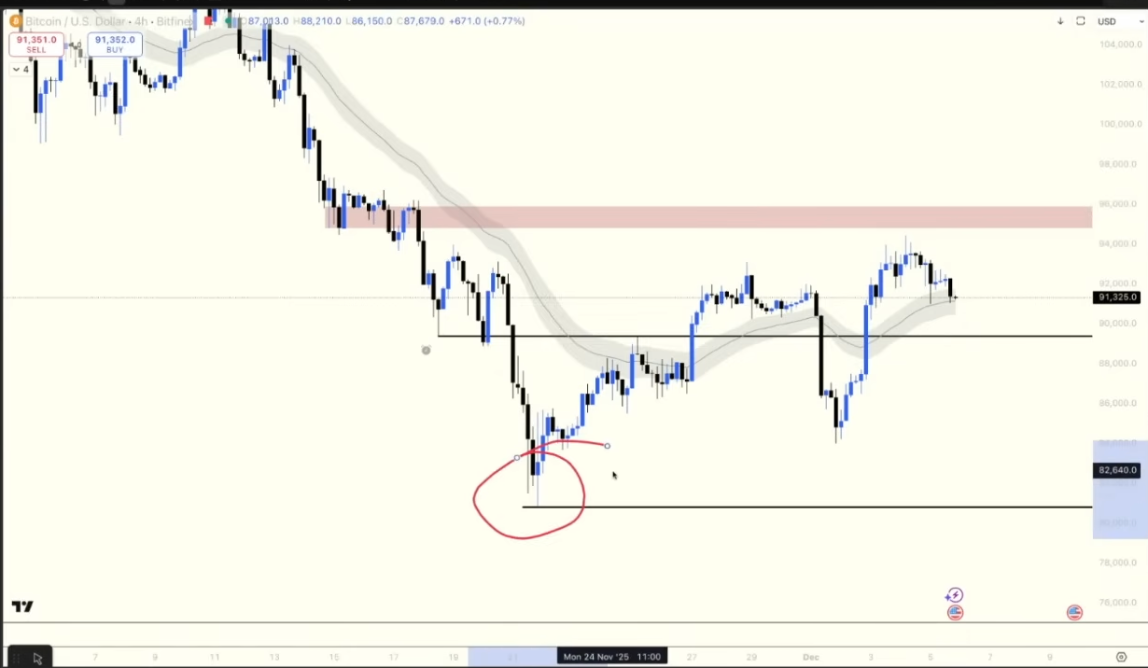
Over the weekend, there were concerns about MicroStrategy's financial health, a spike in Japanese government bond yields, and even news about China cracking down on cryptocurrency again, reiterating their negative stance. This caused the market to open lower, but within just a day or two, the price quickly rebounded. As you said, I think this indicates that those who wanted to sell at current prices have largely finished selling. In other words, panic selling in the market is nearing its end.
However, the basing process might be complex. In the coming weeks or a month or two, the price might retest the lows around $80,000, or even dip slightly below. Overall, I believe we are currently in a basing phase. Over the next few months or even quarters, the market is more likely to break upwards than continue falling.
Breakthrough and Challenges of Long-Term Resistance Levels
Miles: There is still significant resistance overhead. Looking at the daily chart, we can see the price attempting to break above the moving averages. On the 4-hour chart, the Volume-Weighted Average Price (VWAP) control point (POC) is still around $96,000, forming a clear resistance zone.
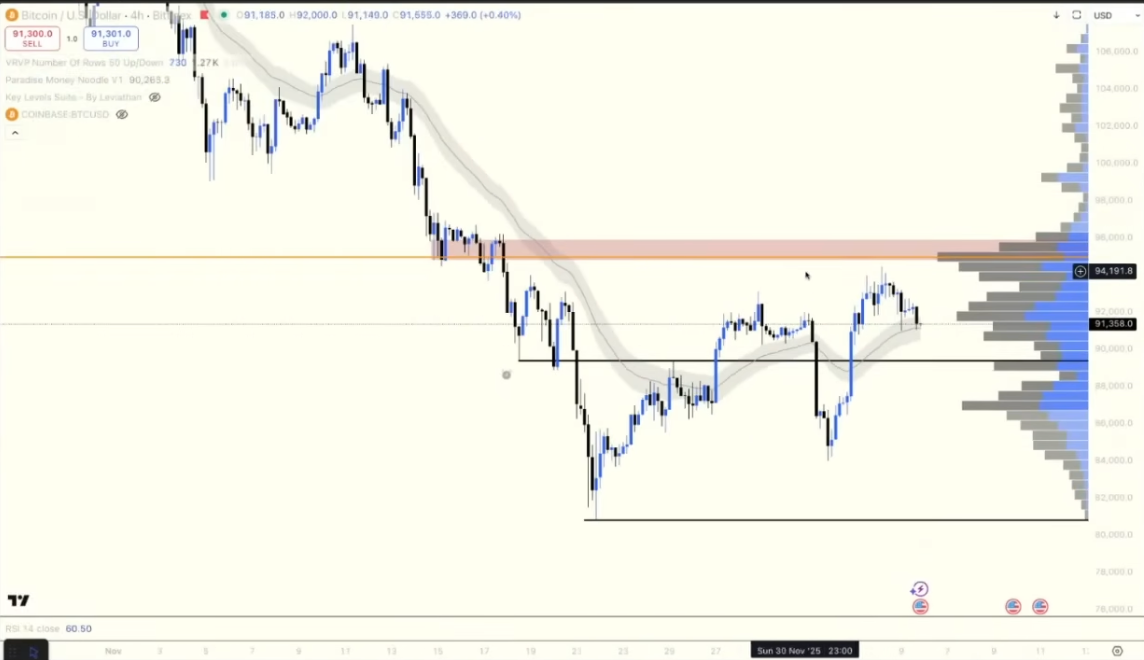
Although the market has rebounded slightly recently, looking at weekly charts and indicators like the 50-week Simple Moving Average (SMA), the price is still below these key levels around $102,000. Therefore, I think the $95,000 to $100,000 range is a difficult area to break through. Until we successfully break and hold above these resistance levels, I won't go all-in on risk assets or altcoins, nor will I take on excessive risk. What's your view?
Fabian:
I completely agree. My usual expectation, especially after such a large move, is that the first rebound to key resistance levels—particularly confluence zones like the ones you mentioned—will inevitably face selling pressure, at least in the short term. As for whether the market can break through these levels in one go, I don't have a particularly strong opinion. However, overall, I think market performance in the coming weeks or even months will be relatively positive. The price might test higher levels, and then we'll see what happens next.
Besides some positive factors within the crypto market itself (like fund flows turning positive), we're also seeing traditional finance (TradFi) returning to a risk-on sentiment. This is an external tailwind for Bitcoin. For example, the VIX index dropped significantly this week, and the US Dollar Index (DXY) retreated from the structural resistance zone of 100-101. At the same time, retail interest in high-momentum stocks (like Robinhood, robotics stocks, etc.) is recovering. These signs indicate improving risk appetite. However, whether Bitcoin can break through the current resistance in one go is hard to say.
Miles: I agree with you. I think the market's reaction to these key levels will reveal more comprehensive information—not just whether the price breaks through, but more importantly, observing fund inflows and outflows. For example, have ETFs turned net positive again? Is market sentiment positive? Do we see high-volume candles indicating investor interest at these levels? Or is this just a brief "dead cat bounce"? Therefore, what truly matters is how the market reacts to these key levels, not just whether the price breaks through or falls below them.
Smart Money's Market Positioning Strategy & Institutional Investor Adoption Trends
Miles: Next, let's talk about the big players in the market and the positioning strategies "smart money" is taking. I find the positioning for 2026 very interesting. I think "smart money" is already preparing for the future market.
First, let's start with Bank of America. Recently, they officially recommended clients allocate 4% of their portfolios to Bitcoin and cryptocurrencies. I think this reflects a long-term trend where banks and financial institutions are gradually opening up to crypto assets. We'll also talk about Vanguard's shift later, but overall, this change in banks is largely driven by deregulation policies and the Trump administration. Fabian, what's your take on the trend of banks gradually opening up cryptocurrency to clients?
Fabian:
I think this is a long-term global trend, potentially lasting for decades. It's not just the US; we'll see more and more similar news globally. I even believe that one day China will change its stance on cryptocurrency, though perhaps not today. Overall, the global adoption trend for Bitcoin and cryptocurrency is almost irreversible. "Up only" is my overall judgment on this trend. Pandora's box is open, and regardless of future US government changes (mid-term elections or the next presidential election), this trend won't reverse.
The core issue for the current market is how the global adoption trend contends with supply bottlenecks. In Bitcoin's early days, a large portion of the supply was concentrated in the hands of a few big players, like early holders or companies like MicroStrategy. As investors, we are essentially trading the liquidity between these two forces. Additionally, I've noticed an interesting phenomenon: the sentiment divergence between Crypto Twitter and traditional financial markets. Many in the crypto community are pessimistic about the market, thinking the cycle is over, while traditional financial institutions view the current market correction as a "buy the dip" opportunity. This long-term perspective is very positive for the market because the dominant force now is these traditional financial institutions.
Miles: I completely agree, which is also why we might see Bitcoin reach new highs next year, or even experience a strong rally. Speaking of "smart money" and the shift among big players, I want to specifically mention the Vanguard case. In 2024, Vanguard's CEO explicitly stated they would not offer Bitcoin ETFs and would not change that stance. However, just a year later, with a new CEO in place, they announced offering Bitcoin ETFs to 50 million clients. As a global top-tier asset manager managing $11 trillion, this shift is highly significant. What's your view on this attitude shift?
Fabian:
This is almost the common path for all major financial institutions. Even leaders who were publicly bearish on crypto, like JPMorgan's Jamie Dimon, now have to accept this trend. It's essentially a "choice of no choice." As publicly listed companies, their primary duty is to create value for shareholders and pursue profits. If they ignore the crypto market, they not only miss out on current and future massive revenue potential but also risk losing clients to competitors offering crypto products. So, regardless of their political stance or personal preferences, they ultimately have to compromise and join this trend; it has become an inevitability.
Sovereign Wealth Funds' Continuous Accumulation & Bitcoin's Long-Term Structural Demand
Miles: Let's talk about sovereign wealth fund positioning, which could be Bitcoin's next major narrative. Today, Larry Fink mentioned something about sovereign wealth funds that I find very noteworthy.
Larry Fink: I can tell you, some sovereign funds are on standby; they were scaling in at $120,000, $100,000, and I know they bought more at $80,000. They are building long-term positions.
He said he knows these funds bought a lot in the $80,000 region, which also explains why we saw such a strong market reaction at that price level. Clearly, big players stepped in at that level.
Regarding the sovereign wealth fund narrative, I think the market currently discusses ETFs and retail investors a lot, even corporate ETFs, but sovereign wealth fund positioning hasn't received enough attention. I know there were rumors that the Trump administration might hold Bitcoin as a strategic reserve, but that plan wasn't fully realized. Although they kept the confiscated Bitcoin, they didn't plan to significantly increase reserves.
This leads me to a point: If you are a country or sovereign fund wanting to accumulate Bitcoin, you wouldn't announce it publicly at the start until you are satisfied with your holdings, or perhaps never announce it at all, because you don't want to be front-run. You just accumulate quietly. As these funds continue buying, market declines become shallower, volatility decreases, but they might not publicly acknowledge it. That's what I find interesting. Fink knows these big players; maybe some countries are secretly accumulating Bitcoin. What's your take on this sovereign Bitcoin narrative? I feel it's under-discussed, but it's clearly an important reason why Bitcoin as an asset is maturing and its volatility is decreasing.
Fabian:
Indeed, that's a very interesting perspective. Over the past few decades, most central banks and sovereign wealth funds have primarily concentrated on holding two types of assets: US assets (like US stocks) and government bonds (both local and foreign, mainly US Treasuries).
However, the safety and diversification capabilities of these two assets have been questioned in recent years. Bond performance has been poor since 2020, and countries overly reliant on US assets expose themselves to systemic risks if the US economy encounters problems. Therefore, we see more and more central banks and sovereign wealth funds seeking diversification.
Currently, there aren't many high-quality assets to choose from. Emerging markets carry higher risks and uncertainty. Among commodities, gold remains the mainstream choice. However, Bitcoin is gradually becoming an attractive long-term diversification tool. While sovereign wealth funds might not increase Bitcoin holdings as rapidly as traditional assets, the process has started from zero allocation to gradual addition, and this trend could continue over the next few years.
Miles: It's not just BlackRock and Vanguard; even JPMorgan is starting to offer structured Bitcoin products based on IBIT to institutional clients. These products not only offer significant returns if Bitcoin prices rise substantially but also have built-in downside protection and risk control parameters. These tools start with Bitcoin ETFs and can then build more complex financial derivatives, like Bitcoin-backed bonds, which is a completely new use case we haven't seen before.
Going further, if these tools become more mature, could we see Bitcoin-backed mortgages? I think this is a sign of Bitcoin's gradual legitimization as an asset class. While this trend is happening, its evolution is slower, not overnight. You might feel pessimistic because Bitcoin's price drops to $80,000, $70,000, or $90,000 in the short term,