


Understanding Opside Token Economics in One Article



first level title
What is Opside
Opside is a decentralized ZK-RaaS (ZK-Rollup as a Service) network. Based on the concept of modular blockchain, Opside designed a three-tier blockchain architecture, adopting PoS & PoW hybrid consensus, providing Web3 developers with the function of generating application zkEVM chains with one click.
In the field of capacity expansion, the concept of L2 is no stranger. However, L2 cannot coordinate various types of hardware resources well, such as data availability, ZKP computing power, packaging nodes, etc., so the concept of modular blockchain has emerged. Opside's 3-layer architecture is further upgraded on the basis of L2, coordinating different modules internally, and providing a ZK-RaaS platform externally.
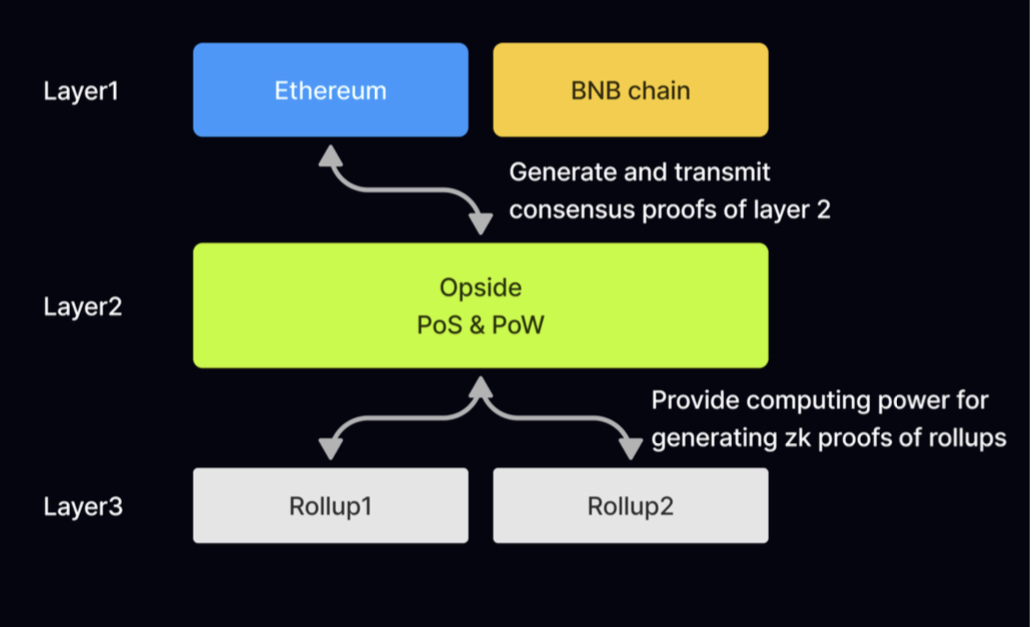
• L1, Public Chain: Ethereum, BNB Chain, Polygon and other public chains.
• L2, Opside Chain: Provide large-scale decentralized consensus, data availability, and ZKP computing power. All generated transactions and data will be packaged and stored on the L2 verification chain. The transaction speed is fast and the handling fee is low.
• L3, Rollup Layer: Rollup moves expensive computation from on-chain to off-chain, enabling scalability.
The various Layers are connected through different types of cross-chain bridges, and assets can be directly transferred from L1 to L2 or L3.
ZK-RaaS
first level title
ZK-RaaS (ZK-Rollup as a Service) provides one-click generation of ZK-Rollup service.
Opside provides a general ZK-Rollups SDK (Software Development Kit), developers can easily
Deploy the ZK-Rollups project on Opside L3.
The ZK-Rollups of Opside L3 are managed by the system contract, including registration, suspension and exit, etc. Developers can own a ZK-Rollup by spending a certain amount of IDE (Opside token) to lease a Rollup slot. This concept is similar to Polkadot slots, but Opside L2 and L3 share the same consensus and data availability layer, which is more secure, more decentralized, and lower maintenance costs.
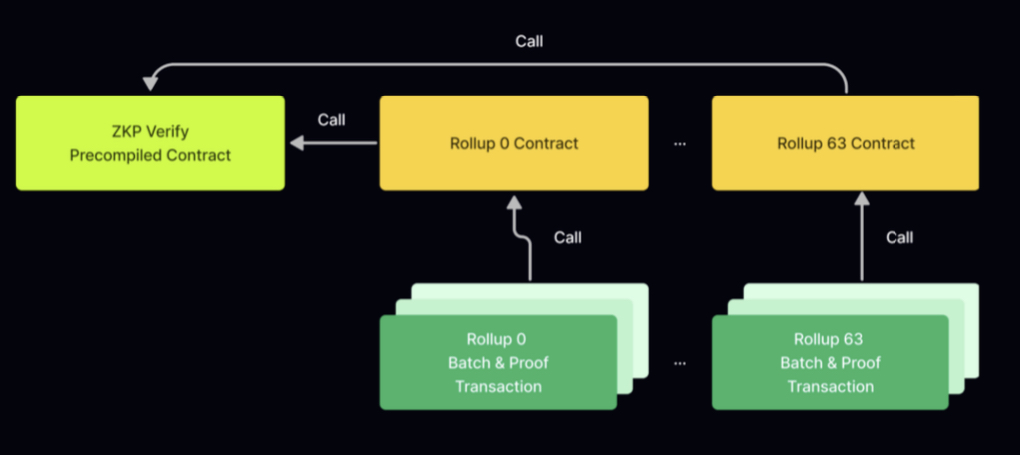
Developers do not need to bear any hardware costs. All hardware resources, including data availability, sequencer, ZKP computing power, etc., are provided decentralized by the following PoS & PoW hybrid consensus.
PoS & PoW Hybrid Consensus
first level title
Compared with OP-Rollup, ZK-Rollup has many advantages, including safer, trustless and faster withdrawal speed. At the same time, there is also a very big difference in technology, that is, ZK-Rollup additionally requires a powerful ZKP computing power to support the generation of zero-knowledge proofs.
In the Opside network, hundreds or thousands of ZK-Rollups may form the Rollup Layer in the future, which will bring a huge demand for ZKP computing power. Therefore, we need to incentivize miners to join this ecology to contribute. After switching from Ethereum PoW to PoS, many Ethereum mining machines have lost their application scenarios. In terms of capital scale, the value of mining machines is 12 billion
Many dollars are currently idle. With the maturity of ZK-Rollup technology, the generation of ZKP requires a large number of FPGA, GPU and other hardware and mining machines to provide computing power. Opside's mixed consensus of PoS and PoW, in addition to using PoS mechanism to motivate Validator to provide data availability, also uses PoW mechanism to motivate Miner to provide ZKP computing power, thus providing complete hardware facilities for ZK-Rollup. This is also one of the core ideas of Opside. All roles, including users, developers, node operators, and miners, can benefit from this Opside economic model.
In addition to allowing ZK-Rollup to inherit the security of the previous layer, Opside also allows ZK-Rollup to inherit the degree of decentralization of the previous layer. Ethereum is now the world's largest decentralized network with more than 500,000 nodes. These nodes not only provide large-scale decentralization, but in the future, thanks to data sharding technology, these more than 500,000 nodes will also provide massive data availability. This is also one of the reasons why Opside chose to improve based on the PoS consensus of ETH 2.0.
Layer 2 (L2)
We expect to have more than 100,000 nodes on Opside. So how to make the degree of decentralization of Rollup reach this level, instead of a single node to complete the centralized packaging? A good way is to let the block proposer of Opside Chain propose the block of Rollup Layer at the same time. For Rollup Layer, it actually completes the separation of builder and proposer: the builder is supported by a P2P network without permission, and the proposer follows the L2 block proposer, thus avoiding the availability risk brought by a single node , but also has a certain resistance to MEV and anti-censorship.
Layer 3 (L3)
• PoS: Opside will adopt the PoS algorithm of Ethereum 2.0 and make necessary improvements to it. Therefore, Opside's consensus layer will have more than 100,000 validators. Anyone can hold IDE tokens and become a validator. In addition, Opside's PoS is provable, and the validator will periodically submit PoS proofs to L1. Validator can get block rewards and gas fees in L2.
• PoS (Sequencer): The validator not only proposes L2 blocks, but also proposes L3 blocks (ie data batch). therefore
The validator is also the sequencer of rollup in L3. The sequencer can get from the transaction fee in the L3 transaction
Earn gas fees.
• PoW (Prover): Anyone can become the prover of rollup in L3 as long as it has enough computing power
A ZK-Rollup is similar to a computer. A computer has two core components, one is the hard disk and the other is the CPU. The data availability provided by PoS is equivalent to a hard disk, and the computing power provided by PoW is equivalent to a CPU. What Opside needs to do is to find a balance between PoS and PoW, so that each role can give full play to its value and benefit from it, so that the large-scale ZK-Rollups network can have better performance and experience.
first level title
Token supply and demand
The distribution rules of Opside tokens (IDE) are as follows: the minting limit is 10 billion IDEs. Among them, 10% is allocated to early financing, 14% is allocated to the Opside team and contributors, and 15% is allocated to the community, including early testnet participants, ecological project parties, and possible airdrops in the future. 28% will be allocated to the foundation and will be used for ecological development, follow-up financing and other purposes. The remaining 33% are allocated to Validator and Miner respectively as rewards for the PoS & PoW hybrid consensus to provide data storage services, generate zero-knowledge proofs, maintain blockchains, run contracts, etc.

According to the PoS & PoW hybrid consensus, block rewards are divided into two parts, PoS and PoW, corresponding to Validator and Miner respectively. In the Pre-Alpha testnet stage, the block reward ratio between PoS and PoW is temporarily fixed at 1: 2, that is, 11% of IDEs are allocated to Validators, and 22% of rewards are allocated to Miners. In the future, the ratio of the two will be dynamically adjusted with the supply and demand of the ZKP computing power of the entire network.
first level title
Rewards for PoS
As mentioned above, Opside adopts the improved PoS consensus based on ETH 2.0. On May 2, Opside has announced the opening of testnet validator node applications. To participate as a Validator, users must deposit a certain amount of IDE into the deposit contract and run three separate pieces of software: Execution Client, Consensus Client, and Validator. These Validators are responsible for checking that new blocks propagated through the network are valid, and occasionally create and propagate new blocks themselves. If the Validator behaves dishonestly or lazy, the staked IDE will be destroyed as collateral.
Under PoS, Opside's block production speed is fixed, and the time is divided into slot (12 seconds) and epoch (32 slots). A validator is randomly selected in each slot as the block proposer. This Validator is responsible for creating new blocks and sending them to other nodes on the network. Also in each slot, a Validator committee is randomly selected whose votes are used to determine the validity of the proposed block. Please refer to ETH PoS for the specific mechanism.
Overall, staking makes it easier for individuals to participate in securing the network, promoting decentralization. Validator nodes can run on regular laptops. Some proxy staking pools even allow users to stake without having enough IDE.
first level title
On Opside's L3, which is the Rollup Layer, each Web3 application can have an exclusive ZK-Rollup. In order to support the demand for massive hardware resources brought by a large number of ZK-Rollups, in addition to the data availability provided by the Validator mentioned above, Opside also provides a unified ZKP computing power market, encouraging miners (that is, provers) to provide for these ZK-Rollups generate ZKPs. This is Opside's PoW mechanism.
secondary title
In the Pre-Alpha phase, within an L2 block, each Rollup can only submit one sequence (can contain multiple blocks of the Rollup). All sequences share the PoW rewards of the current block equally according to the current number of Rollup slots registered. This also means that if there are currently 64 registered rollup slots in total, then in a block of L2, the PoW rewards are divided into 64 equally, and the rewards obtained by each sequence are 1/64 of the block PoW rewards . Of course, some rollups may not submit sequences in some blocks, so the actual inflation of PoW will be lower than expected. In the future, each sequence will estimate the workload based on the corresponding ZK-Rollup type, the number of Rollup transactions included, gas usage, etc., so that different sequences will be priced differently.
secondary title
Two-step commit for ZKP
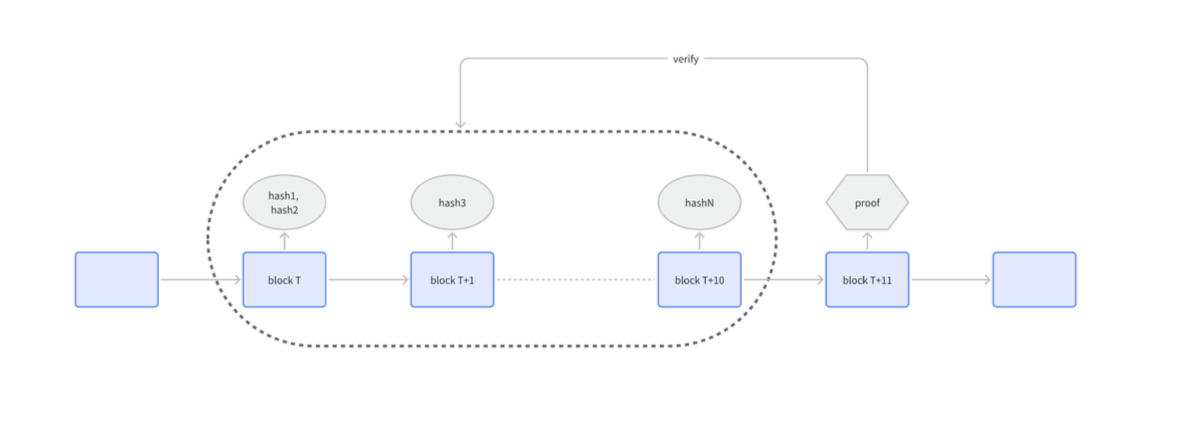
The PoW reward share obtained by a sequence will be distributed to valid ZKP submitters, that is, miners, according to certain rules. When Rollup's smart contract verifies ZKP, it needs the original proof data, which may trigger attacks on the chain. For example, after a certain prover calculates the ZKP, the transaction is broadcast to the transaction pool, and the attacker can see the original proof data. The attacker can set a higher gas fee to send the transaction, so that it is packaged into the block first to obtain PoW rewards. In order to prevent malicious attacks, Opside proposes a two-step ZKP verification mechanism.
1. Submit the hash
• For a certain sequence, after the prover calculates the ZKP, it calculates the hash of (proof / address), and submits the hash and address to the contract, where proof is the proof of a certain sequence, and address is the address of the prover, which must be pledged in advance.
• Assuming that the first prover submits the hash in the T-th block, within the T+10th block, other provers can also accept hash submissions, and there is no limit on the number. In blocks T+11 and after, new prover submission hashes are no longer accepted. 2. Submit ZKP
• From block T+11 onwards, any prover is allowed to submit zkp. As long as one zkp passes the verification, all submitted hashes are verified. Provers who pass the verification can get PoW rewards, and the reward amount is distributed according to the proportion of miners' pledged amount.
secondary title
Prover's pledge and punishment
Prover's pledge and punishment
In order to avoid malicious behavior against the prover, the prover needs to be registered in a special system contract and pledge at least 100,000 IDE. If the current pledge amount is less than the threshold, hash and ZKP are not allowed to be submitted. The rewards obtained by the prover for submitting ZKP will also be distributed according to the proportion of the pledged amount, so as to avoid the malicious behavior of the prover submitting ZKP multiple times. When the prover has the following behaviors, different degrees of punishment will be imposed
• If the prover submits the wrong hash, 10000 IDE will be confiscated
1000 IDE will be confiscated, and the confiscated IDE will be burned. For more details and considerations about ZKP's two-step commit mechanism, please refer to the official documentation. The specific numbers of prover pledges and penalties may change in the future.
secondary title
Opside provides developers with a ZK-Rollup launch base. Developers can register a Rollup slot with one click to have their own ZK-Rollup. All hardware resources of the ZK-Rollup are provided by the Opside decentralized network. Developers need to pay the rent of the Rollup slot to the Opside network, and this part of the rent will be burned directly. In addition to a fixed amount of rent, developers can also provide additional ZKP subsidies for their own ZK-Rollup to incentivize miners to provide computing power. This part will be launched on the Alpha testnet. Readers can find specific rent and subsidy rules and parameters in official documents or code libraries.
first level title
Governance and Development
The functionality and performance of the Opside network will continue to evolve over time, here are a few examples of higher priorities:
• Dynamically adjust the reward distribution ratio between PoS and PoW according to the supply and demand relationship of ZKP computing power in the entire network
• Validator's data fragmentation and data availability sampling will provide more abundant storage space for the entire Rollup Layer, thereby accommodating more ZK-Rollup ecology
• The proposer of Rollup is separated from the builder, so that L3 shares the validator of L2 as the block proposer, inheriting the decentralization of the previous layer
• The optimization of miners' pledge and slash mechanism encourages miners to provide continuous and stable ZKP computing power
• Developers subsidize the ZKP generation of their Rollups to incentivize miners to provide computing power
• Estimate the workload based on ZK-Rollup type, Rollup transaction quantity, gas usage, etc., and establish a personalized pricing mechanism for Rollup batch. These improvements will significantly improve Opside's network utility, thereby promoting the long-term development of ZK-Rollup as a Service development and
Rong.